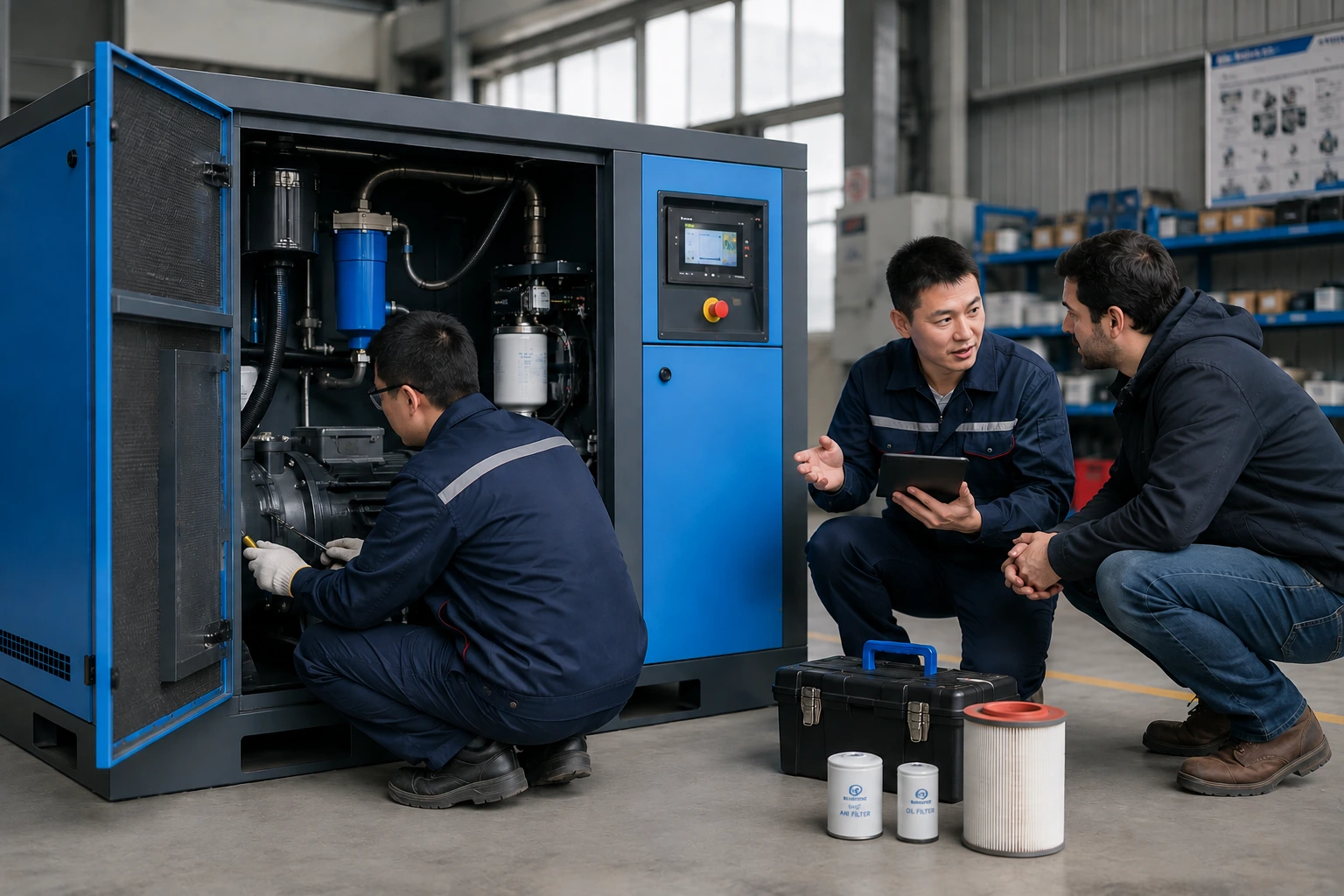
For industrial equipment, customers are never simply buying a machine.
Once an air compressor is installed and put into operation, the real test of a supplier often begins. Can the supplier respond quickly when a problem occurs? Can the technical team identify the cause? Are spare parts available? Can the equipment be restored to operation as soon as possible?
That is why after-sales service should not be treated as an optional extra. It is an important part of the overall value of the equipment.
For air compressors that may operate continuously for many years, good after-sales support should include several key elements.
The biggest concern in industrial production is not simply that equipment may fail, but that no one is available to help when it does.
If an air compressor stops, the impact may extend beyond the compressor itself and affect an entire production line.
For this reason, response speed is one of the most important parts of after-sales service.
When a customer reports a problem, the supplier should quickly collect information such as the compressor model, operating condition, alarm messages, and site situation.
Many problems do not immediately require an on-site visit.
With photos, videos, alarm records, and operating parameters, an experienced technical team can often perform an initial remote diagnosis and help the customer solve common problems more quickly.
Professional after-sales service should not simply tell the customer:
“This part is broken. Replace it.”
The more important task is to identify why the problem happened.
For example, a high-temperature alarm may be caused by a blocked cooler, high ambient temperature, abnormal lubricant condition, cooling fan problems, or other system issues.
If only one component is replaced without identifying the root cause, the same fault may occur again later.
Good technical support should therefore focus on fault analysis and root-cause diagnosis rather than simple parts replacement.
Many equipment problems do not happen suddenly. They develop gradually because of insufficient maintenance.
Air filters, oil filters, oil separators, lubricants, and other service components need to be inspected and replaced according to operating hours and actual working conditions.
If maintenance intervals are ignored for too long, compressor efficiency may decrease, discharge temperature may rise, energy consumption may increase, and the service life of important components may be affected.
A reliable supplier should therefore provide clear maintenance schedules and practical service recommendations.
For distributors and end users, maintenance manuals, operating instructions, video guidance, and technical training can also help local teams operate and maintain the equipment correctly.
Air compressors are long-term industrial assets.
A machine may remain in service for five, ten, or even more years, so after-sales support cannot focus only on the first year after delivery.
The continuous availability of consumables and key spare parts is an important part of a reliable service system.
Common items such as air filters, oil filters, oil separators, sensors, controllers, and other service components should remain available throughout the equipment’s operating life.
This is especially important for overseas customers.
If a small but critical spare part takes a long time to arrive, the cost of production downtime may be much higher than the price of the part itself.
Sometimes a compressor problem is not actually caused by the compressor.
Air receivers, dryers, filters, piping, and downstream equipment can all affect the performance of the compressed air system.
For example, low system pressure may be caused by insufficient compressor capacity, but it may also result from pipeline leakage, excessive filter pressure drop, or a sudden increase in air demand.
Professional technical support should therefore evaluate the complete compressed air system instead of focusing only on one machine.
This broader system understanding often helps experienced technicians identify problems more efficiently.
For exported equipment, it is not always possible to send an engineer to the customer’s site immediately.
Remote technical support therefore becomes extremely important.
Through video calls, operating data, machine photos, and alarm codes, technical teams can guide local distributors or customers through inspections and troubleshooting procedures.
If on-site repair is still required, the necessary tools and spare parts can be identified in advance, reducing unnecessary delays.
For suppliers with local distributor networks, regional partners can also provide faster on-site assistance.
Good after-sales service does not begin only after a fault occurs.
It actually starts during the equipment selection stage.
The correct compressor should be selected according to air demand, working pressure, operating environment, and application requirements.
During installation, ventilation, piping, electrical connections, and equipment foundations should all meet the required conditions.
Before normal operation begins, commissioning and basic operator training should also be completed.
When equipment is properly selected and installed from the beginning, many future problems can be avoided.
A complete service system should therefore cover the entire equipment lifecycle:
Selection, installation, commissioning, training, maintenance, troubleshooting, and spare parts support.
Customers do not simply want someone to answer the phone.
They want their equipment to keep running.
Good after-sales support should help customers prevent failures, shorten downtime, reduce maintenance costs, and extend equipment service life.
For an industrial equipment supplier, product quality may determine whether a customer makes the first purchase.
After-sales service often determines whether that customer comes back for the second one.
Long-term partnerships are built through consistent, professional, and reliable support.
Our engineers will reply with a suitable solution within 24 hours.