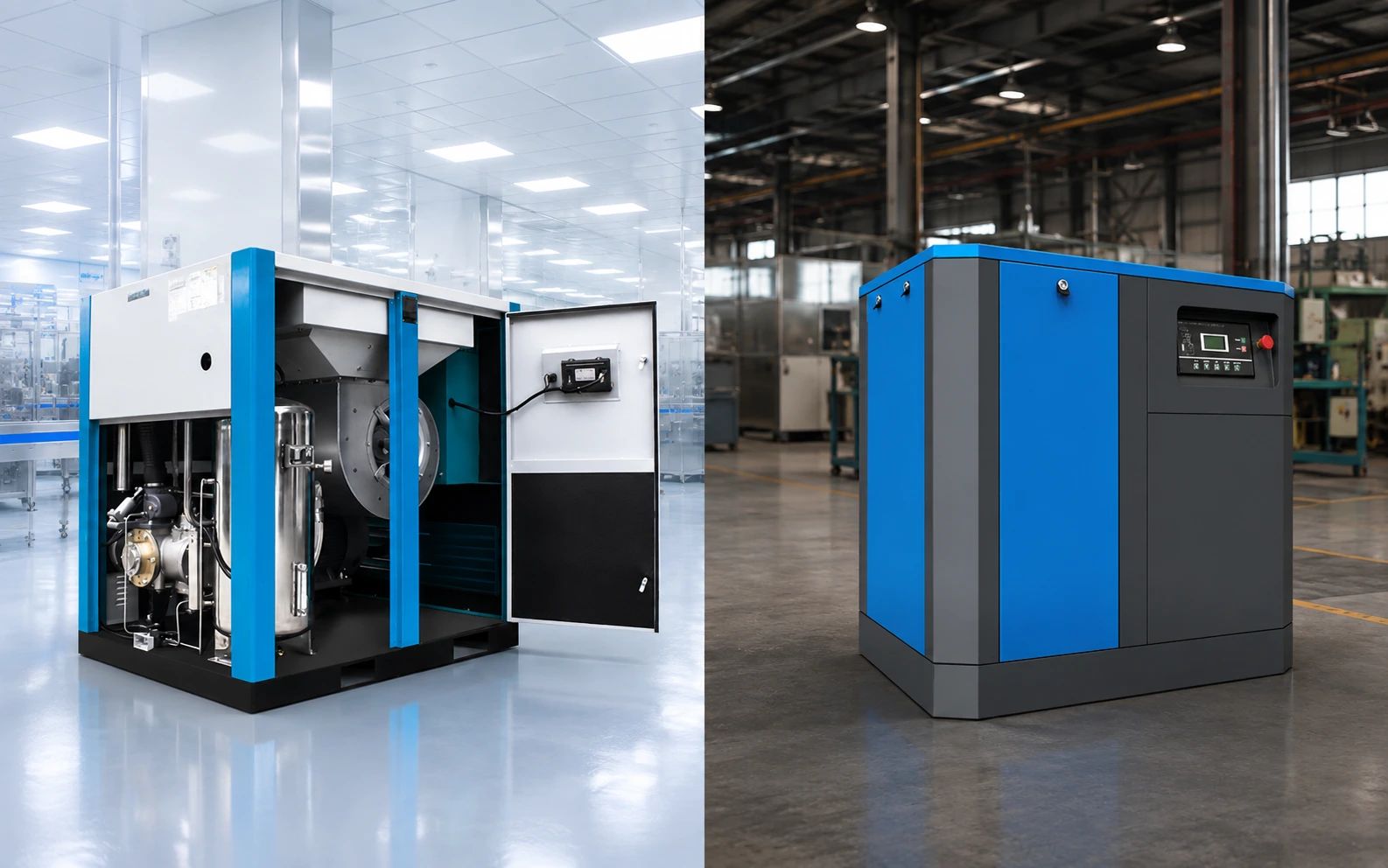
When selecting an air compressor, one of the most common questions is whether to choose an oil-free or oil-injected model.
Both types can provide stable compressed air for industrial production, but they differ significantly in lubrication method, air quality, operating cost, maintenance requirements, and suitable applications.
There is no single option that is always better. The right choice depends on the actual production process, required air purity, budget, and long-term operating conditions.
Oil-injected screw air compressors are widely used in industrial applications.
During compression, lubricating oil enters the airend to provide lubrication, sealing, and cooling. This helps the screw compressor operate efficiently and reliably.
Ruihong’s standard fixed-speed screw air compressor range uses mature screw compression technology and is designed for high efficiency, stable operation, low rotational speed, and long service life.
One of the main advantages of oil-injected compressors is their broad range of applications.
They are commonly used in:
For applications where extremely high air purity is not required, oil-injected screw compressors usually provide a good balance between performance, reliability, and initial investment.
Their maintenance system is also mature, with common service items including lubricating oil, oil filters, air filters, and oil separators.
Oil-free compressors are designed to reduce the risk of oil contamination in the compressed air.
This is especially important in industries where compressed air may directly or indirectly come into contact with sensitive products.
Ruihong’s catalog includes a water-lubricated oil-free screw air compressor, which uses water instead of traditional lubricating oil during the compression process.
According to the product catalog, this design uses corrosion-resistant copper alloy materials and is characterized by low vibration and low noise.
Oil-free compressors are especially suitable for applications such as:
In these applications, reducing the risk of oil contamination can be more important than minimizing the initial equipment cost.
In many cases, customers focus first on compressor power, pressure, or purchase price.
However, the more important question is:
What will the compressed air be used for?
If compressed air is mainly used for pneumatic tools, cylinders, machinery, blowing, assembly lines, or general manufacturing, an oil-injected screw compressor can usually meet the requirements.
If compressed air may come into contact with food, medicine, electronic components, precision products, or other contamination-sensitive materials, an oil-free compressor may be the more appropriate option.
The correct choice therefore depends mainly on the required air quality rather than simply on which compressor type appears more advanced.
Oil-injected compressors use lubricating oil during compression.
As a result, the compressed air normally passes through downstream treatment equipment such as filters and refrigerated air dryers before reaching the final point of use.
Ruihong’s compressed air treatment system includes air receivers, refrigerated dryers, and line filters with different filtration levels, allowing the system to be configured according to different air quality requirements.
For many general industrial applications, a properly designed oil-injected compressor and air treatment system can provide suitable compressed air quality.
Oil-free compressors, on the other hand, are designed to minimize oil contamination risk directly during the compression process.
However, “oil-free” does not mean that no air treatment is required.
Moisture, particles, and other contaminants in the air may still need to be removed through drying and filtration equipment.
Oil-injected screw compressors generally have a lower initial investment and are widely used across general industrial markets.
Oil-free compressors typically require more specialized designs, materials, and manufacturing processes, which can result in a higher initial equipment cost.
However, purchase price should not be the only factor considered.
In industries where oil contamination may affect product quality, cause production losses, or damage sensitive processes, the cost of contamination can be far greater than the price difference between compressor types.
For this reason, oil-free compressors can provide additional value in high-purity applications.
For general manufacturing without strict air purity requirements, oil-injected compressors often provide a more economical overall solution.
Oil-injected compressors require regular maintenance of components such as:
Proper maintenance helps maintain compressor efficiency and extend equipment service life.
Oil-free compressors do not use traditional oil injection in the compression process, but this does not mean they are maintenance-free.
For example, water-lubricated oil-free compressors still require inspection and maintenance of the water lubrication system, filtration components, cooling system, and other critical parts.
Regardless of compressor type, regular maintenance is essential for reliable long-term operation.
The choice can be summarized quite simply.
If your priority is:
Cost-effectiveness, wide applicability, and proven reliability, an oil-injected screw air compressor is usually a practical choice for general industrial applications.
If your priority is:
High air purity and reduced oil contamination risk, especially in food, pharmaceutical, electronics, and other sensitive production environments, an oil-free compressor should be considered.
The final selection should also take into account:
For larger compressed air systems, it may also be necessary to evaluate fixed-speed, variable-speed, multi-compressor control, or oil-free configurations.
Oil-injected and oil-free compressors each have their own advantages.
Oil-injected screw compressors remain a popular solution for general industry because of their mature technology, broad application range, and competitive operating economics.
Oil-free compressors are more suitable for applications where air cleanliness and contamination control are critical.
A reliable compressed air system should be selected as a complete solution rather than focusing only on the compressor itself.
By considering the compressor, air receiver, dryer, filtration system, piping network, and actual production requirements together, companies can achieve a more stable, efficient, and suitable compressed air supply.
Our engineers will reply with a suitable solution within 24 hours.