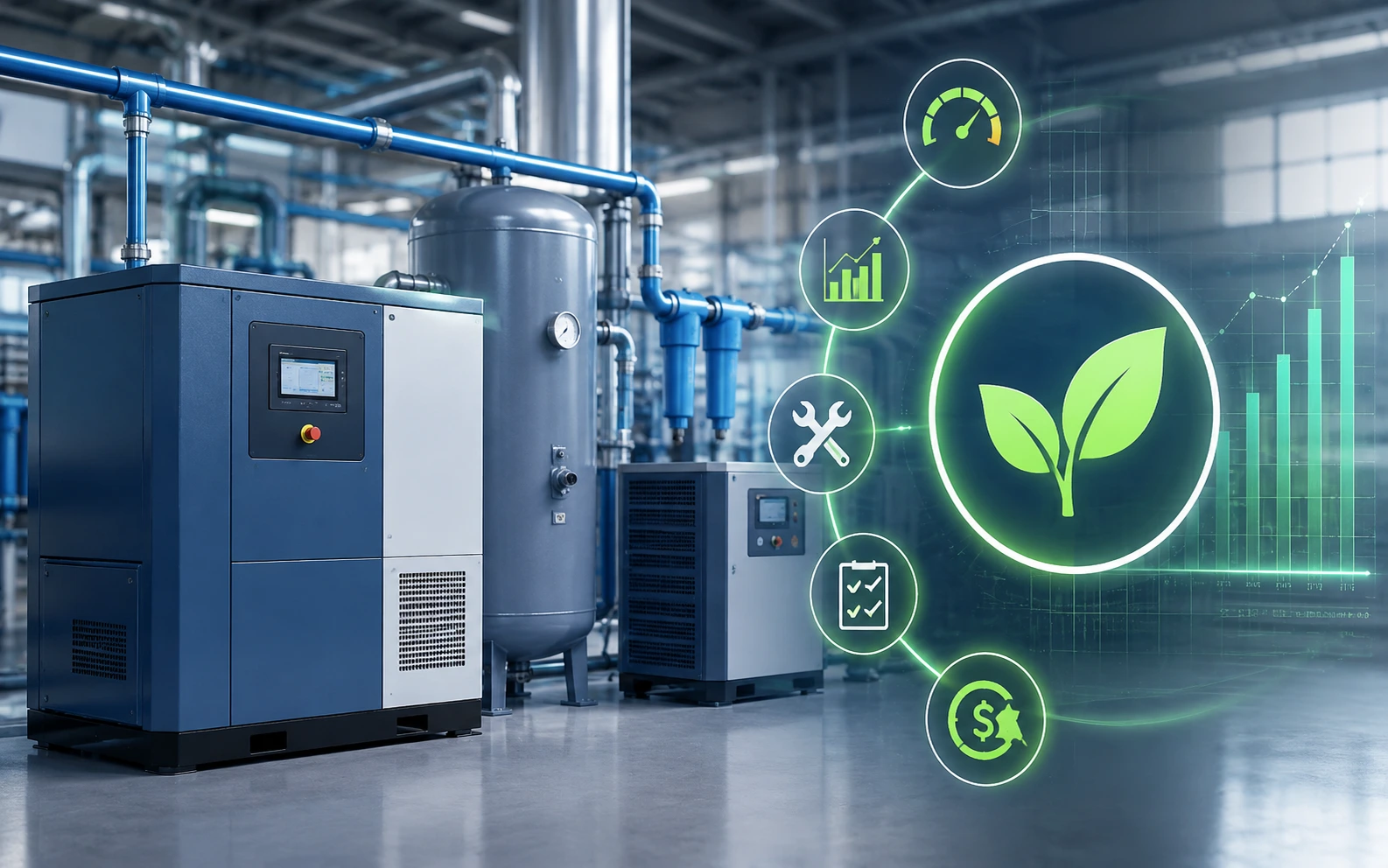
Compressed air is one of the most widely used power sources in industrial production. It is commonly used in manufacturing, metalworking, food processing, textiles, electronics, chemicals, and many other industries.
However, compressed air systems can also account for a significant part of a factory’s energy consumption. Improving energy efficiency is not only about choosing an efficient air compressor. Pressure settings, air leakage, piping design, load variation, and system maintenance all have a direct impact on operating costs.
By optimizing the entire compressed air system, companies can often reduce energy consumption without affecting normal production.
Some factories set the discharge pressure higher than necessary to avoid pressure shortages during production.
However, higher pressure also means higher energy consumption.
When system pressure exceeds the actual requirement, the air compressor consumes more electricity and air leakage losses also increase.
The system pressure should therefore be set according to the real operating requirements of production equipment, while allowing only a reasonable margin for pressure drop.
For example, if the equipment only requires 7 bar, there is usually no need to operate the compressor continuously at 9 bar or above.
Compressed air leakage is one of the most common sources of energy waste.
Leaks may occur at pipe joints, valves, hoses, filters, fittings, and connections to production equipment.
A single small leak may appear insignificant, but multiple leaks throughout a factory can cause the compressor to operate much longer than necessary.
Regular inspections should therefore be carried out across the entire compressed air network.
For larger plants, professional leak detection equipment can also be used to locate leakage points more accurately.
Compressed air demand varies greatly from one factory to another.
If air consumption remains relatively stable, a fixed-speed air compressor can often operate efficiently.
If demand changes frequently because of equipment start-stop cycles, multiple production lines, or significant differences between daytime and nighttime consumption, a variable-speed drive compressor may be a better choice.
A VSD compressor automatically adjusts motor speed according to actual air demand, reducing energy losses caused by unloading and frequent load changes.
Air compressor selection should therefore be based not only on rated power, but also on the factory’s actual compressed air demand profile.
Traditional air compressors often enter an unloaded state after reaching the set pressure.
Although the compressor produces little or no useful compressed air during this period, the motor continues running and still consumes electricity.
Frequent loading and unloading can therefore lead to unnecessary energy consumption.
Properly sized air receivers, optimized control strategies, and multi-compressor control systems can help reduce unloaded running time.
For facilities with highly variable air demand, combining fixed-speed and variable-speed compressors can also improve overall system efficiency.
Piping design directly affects the efficiency of a compressed air system.
Undersized pipes, long transmission distances, too many bends, and high-resistance filtration equipment can create excessive pressure drops.
To compensate for these losses, operators may increase compressor discharge pressure, which further increases energy consumption.
Compressed air piping should therefore be properly sized and unnecessary bends or restrictions should be minimized.
For larger facilities, a ring-main piping system can help distribute compressed air from multiple directions and reduce local pressure fluctuations.
A compressed air system includes more than the air compressor itself.
Air receivers, refrigerated dryers, filters, drains, and piping all influence system performance.
If filter elements are not replaced regularly, pressure resistance can gradually increase.
Poor heat dissipation or blocked condensers in refrigerated dryers can also reduce system efficiency.
Regular inspection and maintenance of air treatment equipment can help minimize pressure losses while maintaining reliable compressed air quality.
Compressed air is convenient, so it is sometimes used for blowing, cleaning, cooling, and other applications where high-pressure air may not actually be necessary.
From an energy-conversion perspective, compressed air is relatively expensive.
For applications that do not require high-pressure air, alternatives such as blowers, electric fans, or other energy-efficient equipment may be more suitable.
Reducing unnecessary compressed air consumption is one of the simplest ways to improve overall system efficiency.
An efficient compressed air system depends on continuous monitoring and optimization.
Pressure sensors, flow meters, and intelligent control systems can be used to monitor system pressure, air flow, operating hours, and energy consumption.
These data can help companies understand:
With continuous monitoring and analysis, operators can adjust compressor operation and improve overall system efficiency.
Compressed air energy efficiency cannot be achieved simply by replacing one air compressor.
Proper equipment selection, reasonable pressure settings, optimized piping, leak management, and regular maintenance all contribute to lower energy consumption.
By evaluating the entire compressed air system, companies can reduce long-term operating costs while maintaining stable production.
As variable-speed technology, intelligent controls, and energy monitoring continue to develop, compressed air systems are becoming increasingly demand-driven, helping factories produce only the amount of compressed air they actually need.
Our engineers will reply with a suitable solution within 24 hours.