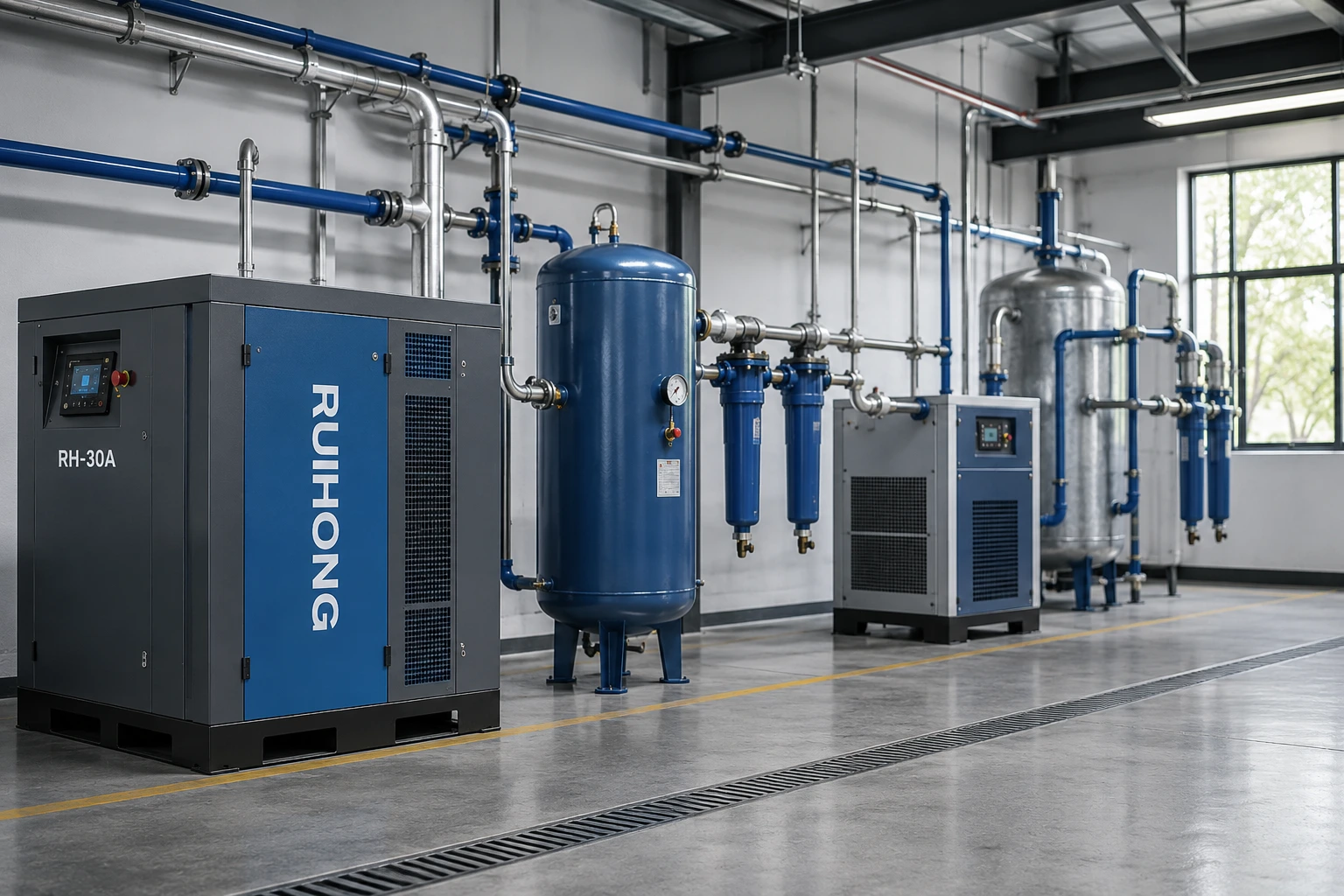
A complete compressed air station is more than just an air compressor. To provide stable pressure, clean air, and reliable operation, the entire system should be planned as one integrated solution.
A typical compressed air station may include the screw air compressor, air receiver tank, air dryer, line filters, piping, drainage system, and other treatment equipment. The correct configuration depends on air demand, pressure, air quality requirements, and the production environment.
The first step is to determine how much compressed air the factory actually needs.
Calculate the total air consumption of equipment that may operate at the same time, including pneumatic tools, production machines, laser cutting equipment, and other air-consuming devices.
It is also advisable to leave a reasonable reserve for future expansion and fluctuations in demand.
Oversizing the compressor can increase purchase and energy costs, while undersizing may cause pressure drops and insufficient air supply.
Different equipment may require different working pressures.
When planning the station, the compressor pressure should not be selected only according to the pressure required by the end equipment. Pressure losses in filters, dryers, pipelines, valves, and fittings must also be considered.
A properly designed system should provide sufficient pressure at the actual point of use without operating at unnecessarily high pressure.
For applications with stable air demand, a fixed speed screw air compressor can provide a simple and reliable solution.
For factories where air demand changes significantly during different production periods, a permanent magnet variable frequency compressor can adjust output according to actual consumption.
Ruihong provides both fixed speed and permanent magnet variable frequency screw air compressors in different power and pressure ranges.
The compressor type should be selected according to operating hours, load variation, energy requirements, and production conditions.
The air receiver tank is an important part of the compressed air station.
It stores compressed air and helps stabilize system pressure during changes in air demand.
It can also assist with cooling and separation of moisture and impurities before the air moves further downstream. Ruihong's product brochure describes the air tank as part of the compressed air post-treatment system for stabilizing air pressure and improving airflow conditions.
The tank size should be matched to compressor capacity and the operating characteristics of the system.
Compressed air contains moisture.
Without proper drying, condensed water can accumulate in pipelines and pneumatic equipment, causing corrosion, contamination, and equipment problems.
A refrigerated air dryer removes moisture from compressed air and is commonly used in industrial compressed air stations.
Ruihong provides refrigerated dryers in different flow capacities for compressed air post-treatment.
The dryer should be selected according to air flow, working pressure, inlet temperature, and required dew point.
Filters remove particles, oil mist, moisture, and other contaminants from compressed air.
Different applications require different filtration levels.
General workshops may use a relatively simple filtration configuration, while industries such as laser cutting, food processing, precision manufacturing, and electronics may require multiple stages of filtration.
Ruihong's compressed air system flow chart shows different filter and dryer combinations for different air-quality requirements.
The filtration system should therefore be designed according to the actual application rather than using the same configuration for every factory.
Poor piping design can waste a significant amount of compressor capacity.
Long pipelines, undersized pipe diameters, excessive bends, and poorly arranged branches can increase pressure loss.
When planning the air station, the piping layout should be simple and efficient.
For larger factories, a ring-main piping system can help provide more stable pressure throughout the production area.
Drain points should also be installed where condensate may accumulate.
Screw air compressors generate heat during operation.
The compressor room should have sufficient ventilation to remove hot air and prevent excessive ambient temperature.
Poor ventilation can cause high discharge temperature, reduced efficiency, and more frequent shutdowns.
The installation area should also leave enough space around the equipment for inspection, cleaning, and maintenance.
Moisture removed from the compressed air system must be discharged effectively.
Air receiver tanks, filters, and dryers may all produce condensate.
Drainage can be handled using manual or automatic drain valves depending on the system design.
Poor condensate management can cause water accumulation in pipelines and reduce air quality.
A good compressed air station should not only operate efficiently—it should also be easy to maintain.
Filters, dryers, compressor panels, valves, and drains should remain accessible after installation.
Equipment should not be installed too closely together simply to save floor space.
Providing enough maintenance space can reduce service time and make routine inspections safer and easier.
Production demand may increase over time.
When planning the station, consider whether additional compressors, tanks, dryers, or production lines may be added in the future.
Leaving suitable space and pipeline capacity for expansion can reduce the cost of future modifications.
A reliable compressed air station requires proper coordination between the compressor, air receiver tank, dryer, filters, piping, drainage, and control system.
The most important factors to consider are:
Ruihong provides screw air compressors, air tanks, refrigerated dryers, line filters, and other compressed air treatment equipment for complete industrial compressed air systems.
A properly planned station can provide stable air supply, improve air quality, reduce energy waste, and support long-term reliable production.
Our engineers will reply with a suitable solution within 24 hours.