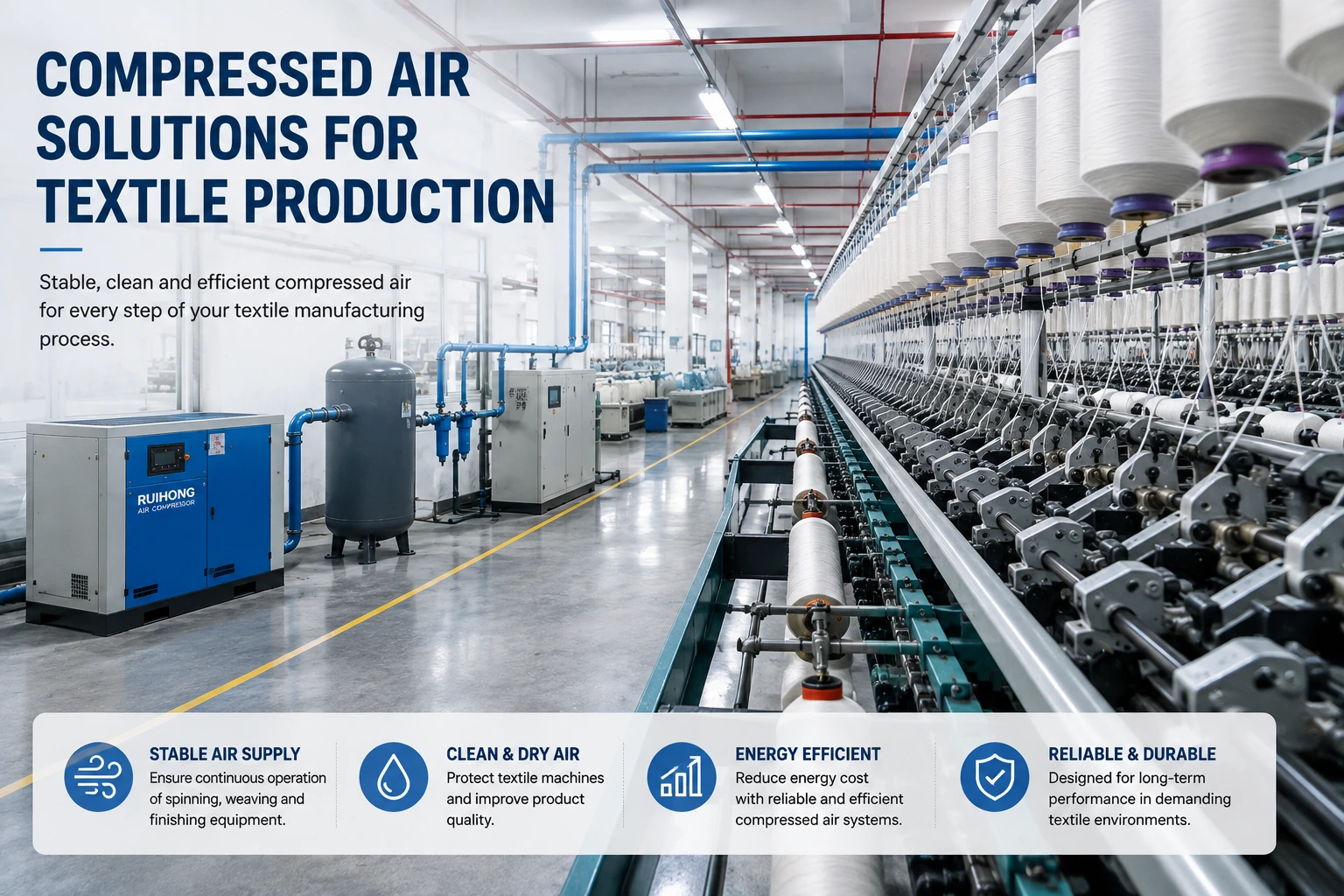
Compressed air plays an important role throughout modern textile manufacturing. From spinning and weaving to dyeing, finishing, cleaning, and automated production, many textile processes depend on a stable supply of compressed air.
Because textile factories often operate continuously and use large numbers of pneumatic devices, the compressed air system must provide reliable pressure, sufficient airflow, and appropriate air quality while keeping energy consumption under control. Ruihong lists textile manufacturing among the industrial applications for its compressed air equipment.
Spinning mills use compressed air for pneumatic controls, cleaning, yarn handling, and other production processes.
Textile production environments can contain significant amounts of lint and dust, so the compressor intake and filtration system should be inspected regularly. Stable compressed air helps production equipment operate continuously and reduces interruptions caused by pressure fluctuations.
Modern weaving equipment contains many pneumatic components.
Air-jet looms in particular require a reliable compressed air supply to support high-speed operation. When pressure is unstable or insufficient, production efficiency and fabric quality may be affected.
For factories with several weaving machines operating simultaneously, compressor capacity should be calculated according to total air demand and peak consumption rather than the requirement of a single machine.
Compressed air can also be used in dyeing, finishing, drying, blowing, control valves, and automated production equipment.
These processes may require cleaner and drier compressed air than basic workshop applications.
Moisture, oil mist, and particles in compressed air can affect pneumatic components and, in some processes, may also influence product quality.
For this reason, the compressor is normally combined with suitable downstream treatment equipment.
A complete textile compressed air system may include:
Ruihong's product range includes refrigerated air dryers, receiver tanks, and precision line filters for compressed air post-treatment.
The dryer removes moisture from compressed air, while filters help remove particles, oil mist, and other contaminants.
Different textile processes may require different levels of air treatment, so the filtration configuration should be selected according to the actual application.
Textile factories may have dozens or even hundreds of compressed-air consumption points operating at the same time.
If the compressor is undersized or the piping system has excessive pressure loss, pressure at the production equipment may become unstable.
A properly sized air receiver tank can help stabilize system pressure and provide temporary air storage during sudden increases in demand. Ruihong's air receiver range is designed as part of the compressed air post-treatment system.
Pipe diameter, pipeline length, bends, valves, and filter pressure loss should also be considered when designing the station.
Textile factories often operate for long hours, but compressed air demand may not remain constant throughout every production shift.
If air consumption is relatively stable, a fixed-speed screw air compressor can provide a straightforward and reliable solution.
When air demand changes significantly, a permanent magnet variable-frequency compressor can adjust its output according to actual consumption.
Ruihong provides both fixed-speed and permanent magnet variable-frequency screw air compressors across multiple power ranges.
The correct option depends on production schedules, load variation, operating hours, and overall energy requirements.
Compressed air systems normally operate for many hours in textile factories, so energy consumption is an important part of long-term operating cost.
Improving system efficiency is not simply a matter of choosing an efficient compressor.
Correct compressor sizing, reducing unnecessary pressure, preventing air leaks, maintaining filters, designing efficient piping, and matching compressor output to actual demand can all contribute to lower energy consumption.
An oversized compressor may consume unnecessary energy, while an undersized compressor may struggle to maintain production pressure.
Textile production can generate fibers, lint, and airborne dust.
This makes routine compressor maintenance particularly important.
Air filters, coolers, ventilation openings, and electrical cabinets should be inspected regularly. Dirty filters or blocked coolers can increase operating temperature and reduce compressor efficiency.
Routine maintenance helps maintain reliable air supply and reduces the risk of unexpected production downtime.
A reliable compressed air system is an important part of modern textile production.
The correct solution should be designed according to air demand, working pressure, operating hours, air quality requirements, production environment, and future expansion plans.
For textile applications, the complete system may include the screw air compressor, receiver tank, dryer, filters, and properly designed piping rather than the compressor alone.
Ruihong provides screw air compressors and compressed air treatment equipment for textile manufacturing and other industrial applications, helping factories build stable and efficient compressed air systems.
Our engineers will reply with a suitable solution within 24 hours.