The Guangdong Provincial Energy Administration recently listed a public consultation on the provincial draft standard “Standard for Efficient Operation of Power Air Compressors (Stations)” (draft for review). According to the official notices board, comments were invited through 20 November 2026. Industry coverage on Compressor.cn the same week explained that the draft is about how to evaluate the operating efficiency of a complete compressor station, not the energy-efficiency grade of a single machine.
For industrial buyers, the direction matters more than any one clause in a draft still under review: comparing only the nameplate efficiency of one compressor is increasingly not enough to judge how much electricity a station will actually use. This article treats the document as a draft under consultation, not as a standard that is already in force. Its later approval and official implementation date remain to be seen.
Industry reports also place this draft in a wider policy shift toward “existing stock” and “system-level” energy saving. Coverage of the GB 19153 revision notes that the evaluation boundary is expanding from the single machine to the compressed air system, including drying and filtration. First-class efficiency on one compressor does not automatically mean first-class efficiency for the station.
By moving station-level operation into a local standard, Guangdong is widely read as taking compressor-station assessment from general advocacy toward something that can be checked in practice. For purchasing and acceptance, the comparison may no longer stop at “which machine has a lower specific power and a lower price,” but may include how much electricity the whole air-supply system uses under real load.
Compressor.cn listed factors that a station-level assessment can bring into view: dryer purge-air consumption, pressure loss across filters, leaks in the pipe network, and group-control strategy. None of these is fully described by a single figure on a compressor nameplate.
In automotive plants, packaging, metalworking, laser cutting and general manufacturing, compressed-air demand is rarely constant all day. Line start-up and shut-down, shift changes and overlapping tool use all make flow and pressure move. If supply cannot follow demand, pressure often runs higher than needed, air is vented, or the compressor loads and unloads too often. That wastes electricity and can increase leakage and wear.
Energy saving therefore cannot stop at replacing the compressor with a more efficient model. Pipe leaks, the pressure drop from filters and dryers, and whether the control system supplies air on demand often decide the electricity bill as well.
A station-level view does not make the compressor itself less important. The machine still has to run stably and efficiently at the actual pressure and at a changing flow. International trade coverage in November 2026 has also highlighted new variable-speed screw ranges, which shows that matching output to demand remains a central theme in the global discussion. Those published saving percentages belong to the manufacturers who issued them. They should not be copied onto another machine or another factory; only the site load and measured data can support a claim.
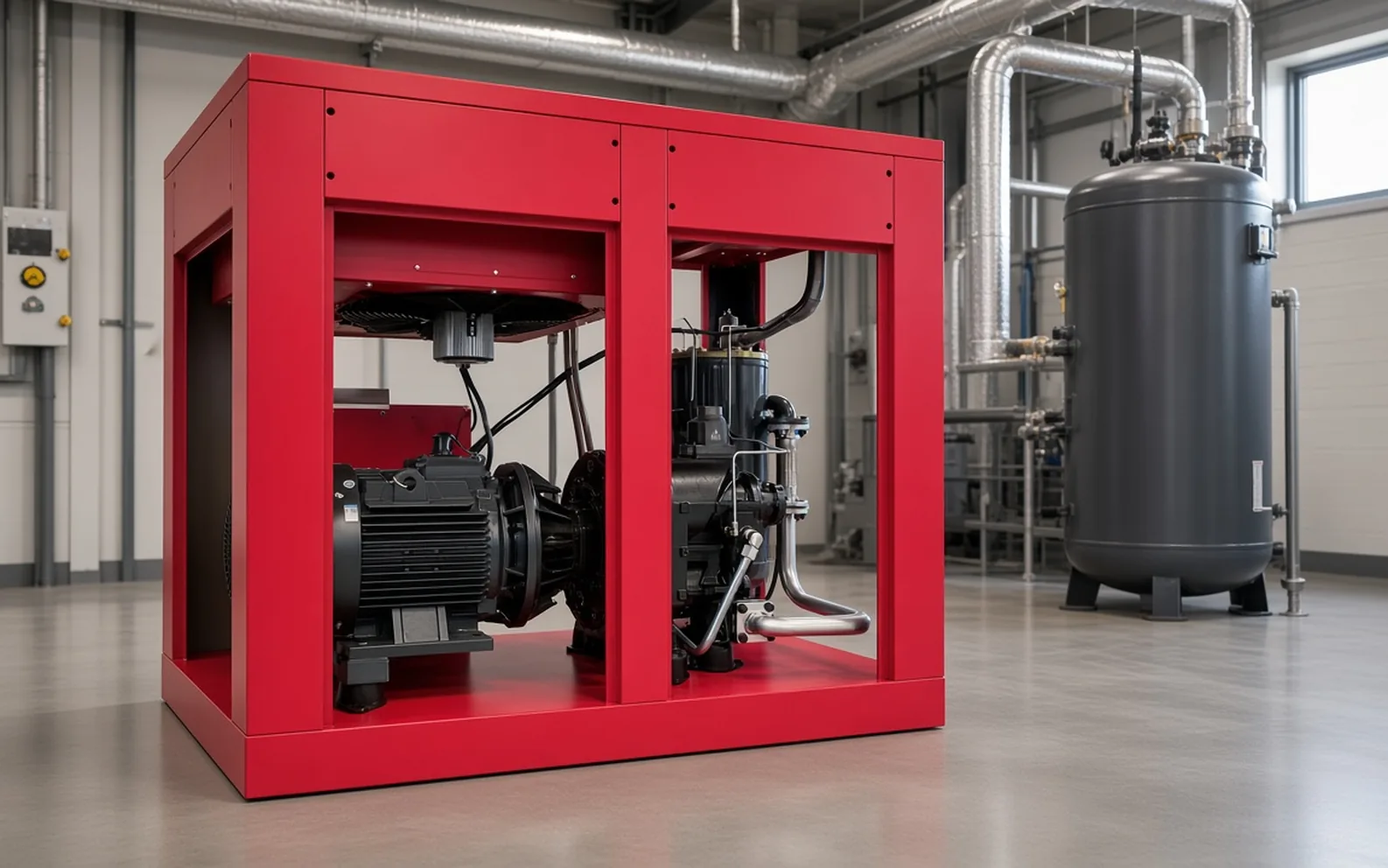
In Ruihong’s current catalogue, the two-stage permanent-magnet VSD screw air compressor is one option for plants that need a steady industrial air supply and also want the machine to follow a changing load. According to the Ruihong brochure, the series covers models RH-PM2T30 to RH-PM2T350, with a power range of 22–250 kW, and free-air-delivery figures at working pressures such as 0.8, 1.0 and 1.2 MPa. Selection should start from simultaneous air demand and required pressure, then be checked against the brochure FAD at that pressure, leaving a reasonable margin for pipe losses and later expansion.
Energy saving in compressed-air stations is moving from “comparing one machine” to “managing the whole system.” For plants that are planning or upgrading a station, it is more comfortable to consider load, air treatment and pipework together now, rather than to retrofit later if assessment rules become tighter.
Our engineers will reply with a suitable solution within 24 hours.